Table of Content
Staring at a mountain of old blog posts, wondering which ones deserve a refresh? You’re not alone. Most content marketers know they should update old content, but the sheer volume makes it feel impossible. Let’s be honest: blindly picking posts to update is a waste of time. This post delivers a weighted scoring system to prioritize your content refresh strategy, so you focus on the updates that drive the biggest impact. And we’re even giving you the spreadsheet to make it dead simple.
Table of Contents
- Why a Content Refresh Strategy Matters
- The Weighted Scoring System: Prioritize Like a Pro
- Content Refresh Criteria Explained
- Download Your Free Content Refresh Scoring Template
- Real-World Examples: Seeing the System in Action
- Frequently Asked Questions
- Conclusion: Refresh Smarter, Not Harder
Why a Content Refresh Strategy Matters
Here’s the thing: your old blog posts are silently bleeding traffic. Content decay is real. What ranked #1 last year might be buried on page two today. Search algorithms evolve, competitors publish new content, and your own information becomes outdated. Ignoring these factors means leaving valuable organic traffic on the table.
Hubspot says that 6% of their monthly blog views came from “old” posts in a blog post. Imagine the impact of revitalizing those assets! It’s not just about rankings; it’s about providing current, accurate, and valuable information to your audience.
Think of it this way: refreshing content is like renovating a house. You’re not building from scratch; you’re improving what already exists, saving time and resources while increasing its value.
The Weighted Scoring System: Prioritize Like a Pro
Stop guessing and start scoring. Our weighted system considers four key factors to identify the blog posts with the highest potential for improvement:
- Current Ranking Position: Where does the post currently rank for its target keywords?
- Traffic Trend: Is traffic increasing, decreasing, or stagnant?
- Backlink Count: How many backlinks does the post have?
- Content Freshness Decay: How old is the post, and how much has the topic evolved since publication?
Now, you might be thinking: “That sounds complicated.” But it’s not! Let me show you what I mean:
Content Refresh Criteria Explained
Each factor is assigned a weight based on its relative importance. You’ll then score each blog post against these criteria. Add up the weighted scores, and you’ll have a prioritized list ready for action.
-
Current Ranking Position (Weight: 30%)
Score based on average ranking for primary and secondary keywords:
– Page 1 (Positions 1-3): 5 points
– Page 1 (Positions 4-10): 4 points
– Page 2 (Positions 11-20): 3 points
– Page 3 (Positions 21-30): 2 points
– Page 4+: 1 pointWhy this matters: Posts already ranking well are easier to boost to the top spots.
-
Traffic Trend (Weight: 30%)
Analyze traffic data over the past 6-12 months:
– Increasing >20%: 5 points
– Stable (+/- 10%): 3 points
– Decreasing >20%: 1 pointWhy this matters: Declining traffic signals content decay and an urgent need for updates.
-
Backlink Count (Weight: 20%)
Count the number of referring domains:
– 20+ Backlinks: 5 points
– 10-19 Backlinks: 4 points
– 5-9 Backlinks: 3 points
– 1-4 Backlinks: 2 points
– 0 Backlinks: 1 pointWhy this matters: Backlinks are a strong signal of authority. Posts with existing backlinks are more likely to benefit from a refresh.
-
Content Freshness Decay (Weight: 20%)
Assess the post’s age and relevance:
– Published < 6 months ago: 5 points (Low Decay)
– Published 6-12 months ago: 4 points
– Published 1-2 years ago: 3 points
– Published 2-3 years ago: 2 points
– Published 3+ years ago: 1 point (High Decay)Why this matters: Older content is more likely to contain outdated information or miss new developments.
Download Your Free Content Refresh Scoring Template
Ready to put this system into action? Download our free, customizable content refresh scoring template. It’s pre-loaded with the formulas and weights described above, so all you have to do is enter your data and watch the magic happen.
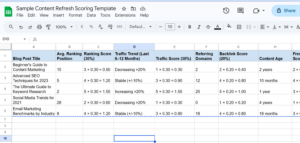
Sample Content Refresh Scoring Template – Sample template
And this is where most people stop but you shouldn’t: Let’s walk through some real-world examples.
Real-World Examples: Seeing the System in Action
Let’s look at three hypothetical blog posts and how the scoring system helps prioritize them:
-
Post A: “Beginner’s Guide to Content Marketing”
– Current Ranking: Page 2 (Position 15) – Score: 3
– Traffic Trend: Decreasing >20% – Score: 1
– Backlink Count: 2 Backlinks – Score: 2
– Content Age: 2 years old – Score: 2
– Weighted Score: (3 * 0.3) + (1 * 0.3) + (2 * 0.2) + (2 * 0.2) = 2.0Verdict: Low priority. Needs significant work and may not yield immediate results. Consider pruning if other factors are also negative. [INTERNAL LINK: suggested anchor text → content pruning guide]
-
Post B: “Advanced SEO Techniques for 2023”
– Current Ranking: Page 1 (Position 5) – Score: 4
– Traffic Trend: Stable (+/- 10%) – Score: 3
– Backlink Count: 12 Backlinks – Score: 4
– Content Age: 10 months old – Score: 4
– Weighted Score: (4 * 0.3) + (3 * 0.3) + (4 * 0.2) + (4 * 0.2) = 3.7Verdict: Medium priority. Has potential to reach top 3 with targeted updates and link building.
- Post C: “The Ultimate Guide to Keyword Research”
– Current Ranking: Page 1 (Position 2) – Score: 5
– Traffic Trend: Increasing >20% – Score: 5
– Backlink Count: 25 Backlinks – Score: 5
– Content Age: 1 year old – Score: 3
– Weighted Score: (5 * 0.3) + (5 * 0.3) + (5 * 0.2) + (3 * 0.2) = 4.6Verdict: High priority. Already performing well, a refresh will likely solidify its top ranking and drive even more traffic. Focus on keeping it current and comprehensive.

Bottom line: this scoring system gives you clarity and focus. Instead of randomly updating posts, you’re making data-driven decisions that maximize your ROI.
Frequently Asked Questions
Q: How often should I refresh my blog content?
A: There’s no one-size-fits-all answer, but aim to review your top-performing content every 6-12 months. For rapidly changing topics, consider more frequent updates. Use the scoring system to identify which posts need immediate attention and create a manageable refresh schedule.
Q: What are the benefits of a content refresh strategy?
A: A content refresh strategy boosts organic traffic, improves search engine rankings, enhances user engagement, and extends the lifespan of your content. It also helps you maintain authority in your niche and provide ongoing value to your audience, driving long-term results.
Q: How do I measure the success of a content refresh?
A: Track key metrics like organic traffic, keyword rankings, bounce rate, time on page, and conversion rates before and after the refresh. Use Google Analytics and Google Search Console to monitor these metrics and identify areas for further optimization. Set clear goals and measure your progress against them.
Q: What tools can I use to identify content refresh opportunities?
A: Google Analytics and Google Search Console provide valuable data on traffic trends and keyword rankings. SEO tools like Ahrefs, Semrush, and Moz can help you analyze backlinks, identify content decay, and track competitor performance. Our scoring template streamlines the prioritization process.
Conclusion: Refresh Smarter, Not Harder
The key takeaway? A strategic content refresh isn’t just about making cosmetic changes; it’s about maximizing the ROI of your existing content assets. By using a weighted scoring system, you can focus your efforts on the updates that will deliver the biggest impact on your organic traffic and overall SEO performance.
Now, put this system to work! Download the template, score your posts, and start refreshing your way to higher rankings and more traffic. And if you found this helpful, share it with another marketer!